Screen Shot 2014-06-03 at 5.13.03 PM

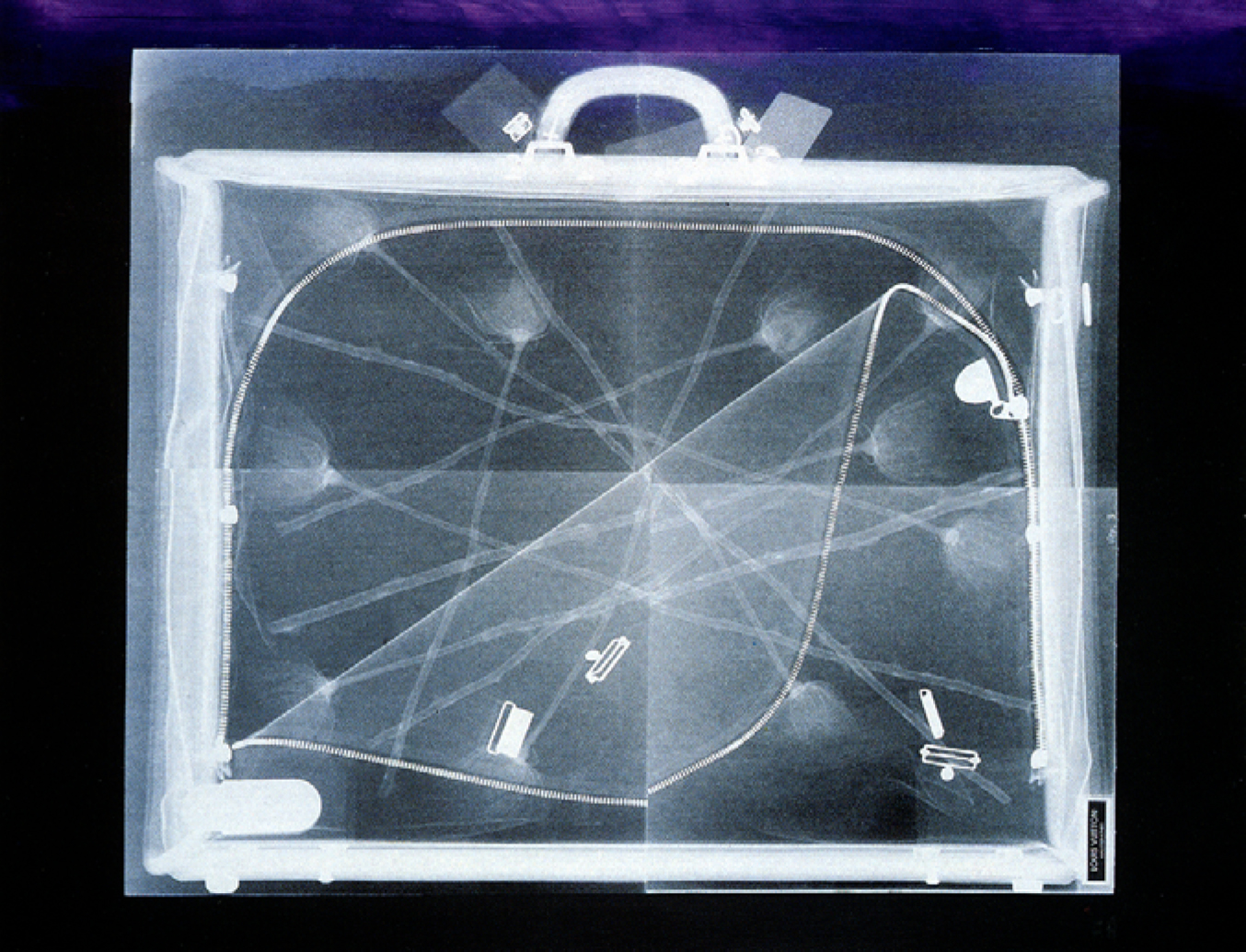
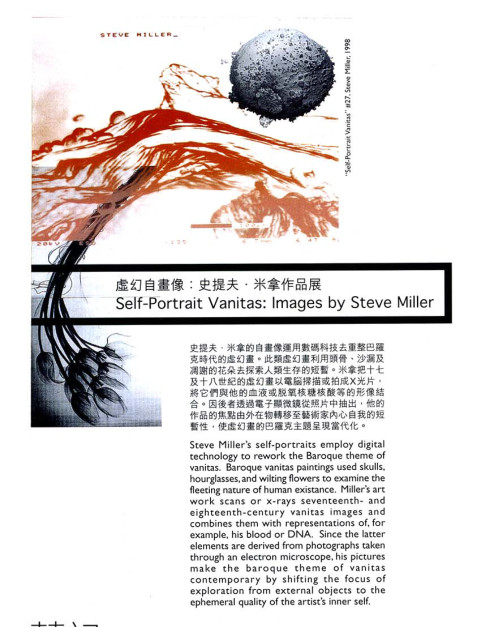
 “Self-Portrait, Vanitas” 

March, 1999

Hong Kong, China
 

Artslink99001.pdf


2014-06-03T21:48:38-04:00

Shizaru Gallery, “Bad for You”

Screen Shot 2013-10-08 at 1.54.35 PM

Shizaru Gallery Presents:
BAD FOR YOU

October 10th – November 23, 2012

London, England


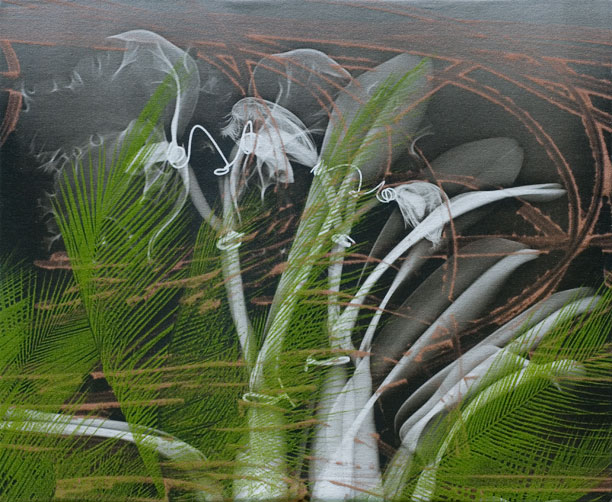
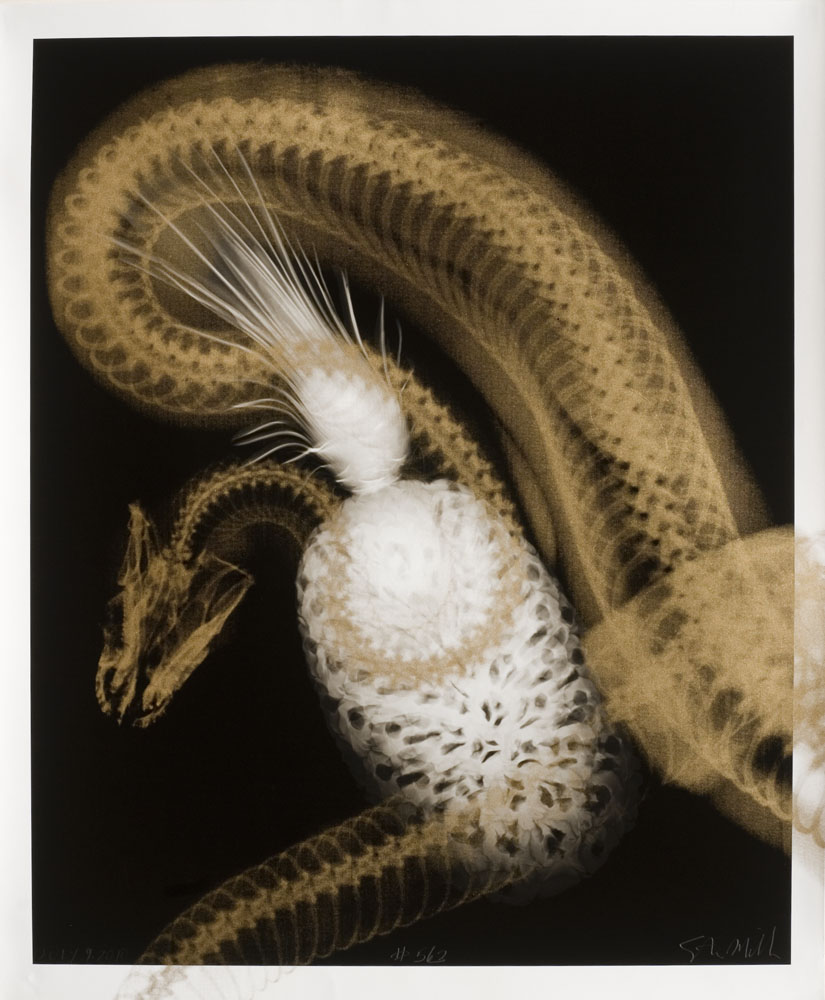
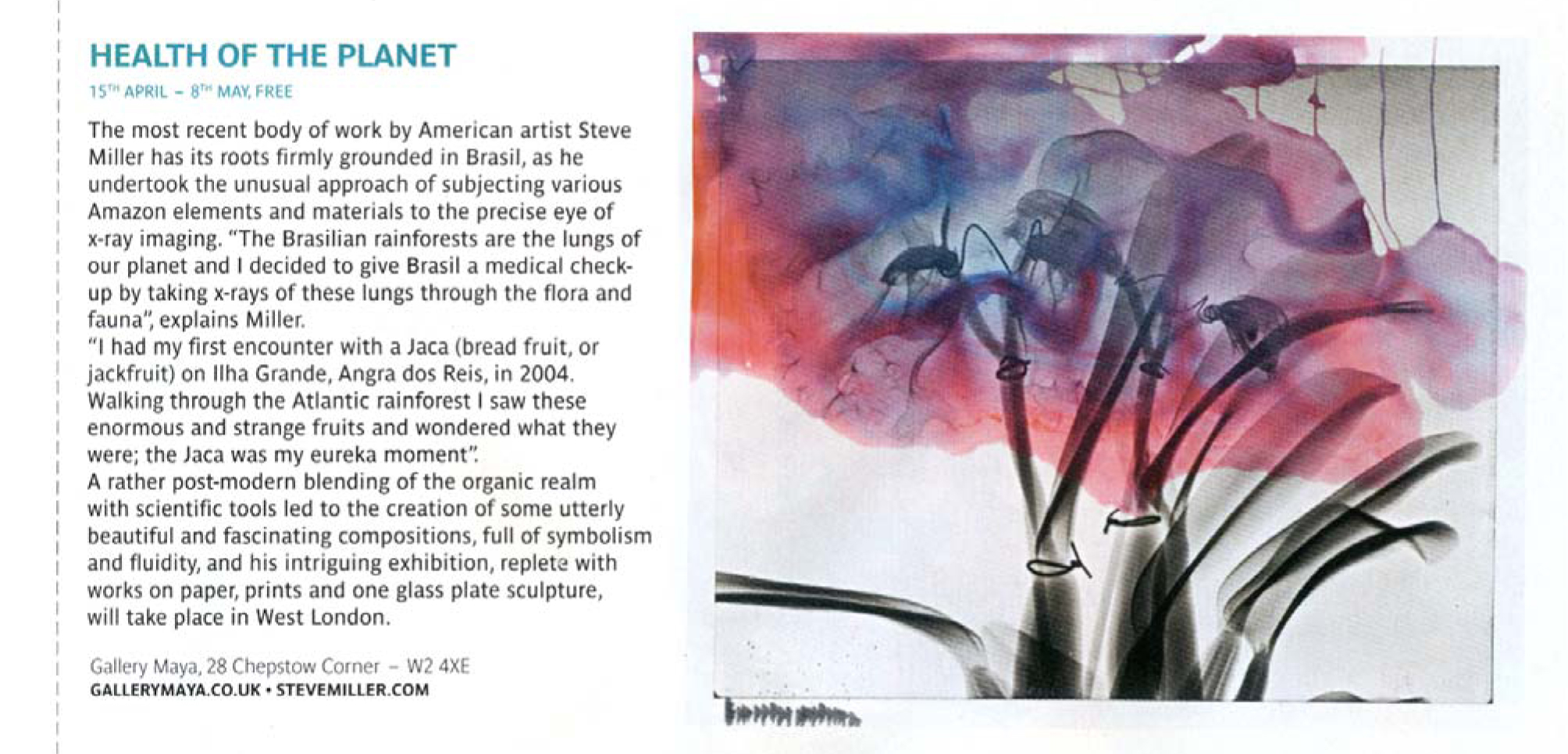
#563- 29Óx24Ó carbon ink jet & silk screen 7/9/10“Health of the Planet #563” 2010, carbon ink jet & silk screen,   29”x24”  private London collection

As the international community ?ocks to London for Frieze, Shizaru is delighted to host BAD FOR YOU, an
exhibition curated by Beth Rudin DeWoody featuring sixty-eight contemporary and established artists
primarily from America. Taking inspiration from its eponymous title, BAD FOR YOU highlights the unwavering
relationship between art and vice, displaying the human relationship with what is ?bad? through issues like self
destruction, drugs, alcoholism, gambling, materialism, vanity, and cigarettes. A title that is at once humorous and
grim the exhibition avoids judgment, allowing the viewer to draw their own conclusions.
Artists explore these many themes through various moralistic viewpoints. Some works celebrate, disregard and
revel in what is seen as being ?Bad? whilst others raise alarm and aim to forewarn the consequence of a life of
decadence. Artists celebrate the excitement of experimentation, and the pleasure that comes with doing what is
?Bad for You? such as Fred Tomaselli, who revels in his chosen vice; drugs, by making decorative patterns out
of marijuana leaves and Liz Markus, whose humorously titled “Fuck it” evokes the carefree attitude of “doing it
anyway”. These words written on raw canvas next to a whiskey bottle depicts that vertiginous moment, when
one decides to carelessly down the rest of the bottle.

Many works explore human desire and the thrills that tempt us to rebel. The glitzy plethora of fortune is
presented by Tony Oursler in his video installation “Bedazzled, Set for Life, Funky $5, Mother’s Day, Welcome
to Vegas” which captures a stack of various gambling scratch-off cards, alluding to the temptations that can lure
one into a rip of false promise.

Shizaru 

Shizaru Gallery, “Bad for You”2013-10-08T18:58:01-04:00

Contentations

STEVE MILLER: Crossing the Line

Signal Relay, 2003, dispersion and silk screen on canvas, 50″ x 37.5″

STEVE MILLER (www.stevemiller.com) is a photographer, painter, and sculptor who has been making work at the intersection of art and science for over three decades. In his current exhibition at the National Academy of Sciences titled Crossing the Line, Miller presents a body of work based on his long-term collaboration with Nobel Prize-winning neurobiologist and biophysicist Rod MacKinnon. Curated by Marvin Heiferman, the show expands on an earlier exhibition by the artist that took place at the Rose Art Museum at Brandeis University in 2007. For the catalogue for the earlier show, which was curated by Michael Rush and titled Spiraling Inward, an extensive interview was conducted between Heiferman and Miller. What follows is an abbreviated version of that interview prefaced by Heiferman’s introductory essay for the current show along with a selection of images from both exhibitions. Concatenations thanks both curator and artist for permitting the republication of the texts here, and the artist for providing such a wealth of images.

Crossing the Line: Paintings by Steve Miller will be on view at the National Academy of Sciences in Washington, D.C. through January 13, 2014. The catalogue for the show can be accessed here:Crossing the Line catalogue. The catalogue for the show at the Rose, which contains essays by Michael Rush and Mark Auslander in addition to the full interview, can be found here: Spiraling Inward catalogue.

Factory, 2008, dispersion and silk screen enamel on canvas, 80″ x 120″
Crossing the Line: Paintings by Steve Miller 
By Marvin Heiferman 

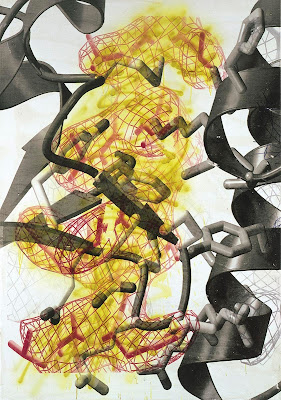
Over the past decade, Steve Miller has made numerous and provocative artworks based upon his collaboration with Rod Mackinnon, a Nobel-Prize winner in Chemistry in 2003. They met at Brookhaven National Laboratory in New York, when Miller, interested in advanced imaging, was working with scientists there and MacKinnon was investigating protein structures in order to better understand their functioning. Scientists and artists routinely make and rely upon images to problem solve in the course of their work. And so it was not surprising that Miller became fascinated with the visual nature, vocabulary, and tools of MacKinnon’s work: the graphic quality of his calculations and diagrams, the computer modeling he experimented with to grasp the three dimensionality of proteins, and X-ray crystallography technology itself.

MacKinnon was investigating how potassium ions moved across cell membranes. Miller’s work engages itself with the crossing of borders as well: moving back and forth between photography and painting, shifting from micro to macro scale, combining representational and abstract imagery and what is theorized with what can be seen.

Commenting on his long-standing interest in working with scientists, Miller says, “we’re all asking questions, trying to understand what forces make or shape who we are.” For him, art and science are parallel dialogs about possibility; when they intersect, the context of each changes. What results, as these paintings reveal, can be unexpected, engaging, and powerful.

We Need the Following Qualities, 2007, dispersion and silk screen on canvas, 38.5″ x 29″

Every Body a Spectacle: An Interview with Steve Miller

By Marvin Heiferman

Today, electronics and automations make mandatory that everybody adjust to the vast global environment as if it were his little home town. The artist is the only person who does not shrink from this challenge. He exults in the novelties of perception afforded by innovation. The pain that the ordinary person feels in perceiving the confusion is charged with thrills for the artist in the discovery of new boundaries and territories for the human spirit. He glories in the invention of new identities, corporate and private, that for the political and educational establishments, as for domestic life, bring anarchy and despair. — Marshall McLuhan, 1968 [1]

Marvin Heiferman: This quote by Marshall McLuhan, which I find myself returning to often, seems to suggest some ways to start this conversation about your work. In the past, you and I have talked about artists’ contributions to the visual language and their responses to the technology of their time. What is the visual language at work in your work.

Steve Miller: Visual language today is complex; I don’t think we can really say it is one thing or another. At first, I responded to McLuhan’s claim, that artists are the only people who don’t shrink from the challenge of facing up to novel perceptions, by saying, “Oh, yeah. Absolutely right.” But now that I’m thinking about it—and about Google, YouTube, and MySpace—it seems like everyone today is more comfortable communicating with and through technology, which I think is the point of the exhibition, in a way. What used to be considered specialty languages no longer are.

People understand that information, image, and language systems can change and change quickly. Every artist I know uses Photoshop, and so does everyone else. Anyone can capture and manipulate images—adjust, annotate, and distribute their snapshots, animations, and home movies. Today, visual culture is much less specialized than when I started out.

MH: When was that, and what kinds of ideas, images, and issues interested you then?

SM: In the early 1980s, I started to use computers to manipulate and translate images. I became increasingly interested in what happened when an image was reprocessed. Back then, you could put an image onto a computer and digitize it, have it automatically morph into another form of visual language, which seemed advanced at that time. You went to specialty studios and worked for hours on what can now be accomplished by pressing a single button on a home computer. But what was important to me was the notion that you could take an image, put it through a translation system, and automatically code it.

MH: If we’re talking about the visual language of culture at a specific time, can you talk about the images and specialized visual vocabularies of the time that you wanted to explore?

SM: My interest in the visual language of science and technology grew out of my growing disenchantment with painting. The habitual gestures of making paintings had become frustrating and were feeling meaningless. But because I like making paintings, I was caught in a contradiction. I was bored and frustrated, but I was still looking for new ways to bring some energy into the work. I started looking at Rorschach blots because they gave me a preexisting image to work with—somebody else’s piece of paint, not my own. In the course of appropriating those forms, I inherited their content. Since I didn’t want to paint Rorschach blots, I scanned images of them on a computer, made silk screens of them, and began to print them on canvas. By not being responsible for the image, by not being responsible for physically and traditionally painting an image, by having the meaning taken out of my hands, I found a perfect way to keep painting going for myself.

MH: But, then, what was left for you to do?

SM: What I started to appreciate was that inkblots tested for a kind of content I hadn’t been thinking about when I started this work. I was using images from science that were used to test, on some level, someone else’s psychic energy. Rorschach blots, from what I understand, while no longer used much, had once been thought useful in revealing pathology. Because the pathological aspects of culture fascinate me, I began to think about what else would constitute literal images of pathology. I started looking at medical textbooks, at images of viruses and cancers. I was interested in them both for what they were and what they looked like—completely abstract images as seen through an electron microscope. This was in 1987, when images like these weren’t widely reproduced. Looking at them was like being under water in a coral sea, or being on the moon surrounded by lunar rocks. All of a sudden, I realized there was a whole other world that couldn’t be seen by the eye but could be visualized through new technology. And the content of the images was really powerful, even if not very directly, at first, for a lay viewer.

MH: What interests me about images, all images, is that different communities make images for specific purposes and understand and use them differently, depending on their need, knowledge, and perspective. What was it like for you, a visual artist, to throw yourself into this new visual language of medical and scientific imagery?

SM: The beauty of these images, to me, is they are the biological, technological, scientific equivalents of the Rorschach blots. I didn’t know what these images meant; neither would anybody who wasn’t a scientist. So, to answer your question, a scientist might look at an image and see technical information. (“This is the virus.” “This is the cancer cell.” “This is the healthy cell.” “This is the cell in the bloodstream.”) A contemporary art observer, looking at the same image, sees something perhaps closer to surrealism, a crazy juxtaposition of unknown things. What became interesting to me about the work was that, in an art context, images that were literal and useful to some became abstract and useful in another way to others. Unless I specifically name the images, you don’t know what they are. So, viewers have the possibility of looking at paintings in a state of fantasy, of projecting onto them, or, at some point, going deeper and finding out what the images actually are of and about.

MH: How important is it, to you, that people know what they’re looking at?

SM: At one level, not important at all. I think art, especially painting, has to sustain viewing and work off of a certain level of visual interest. That has to do with aspects of surface, size, composition—all the technical, formal aspects of making a picture. Then, there’s that other aspect of engagement, when an artwork starts making you ask questions. In the case of my work, it’s logical to ask, “What is that? What am I looking at?” And if you do, that takes you to the next level of involvement. In the case of the work in this exhibition, if the wall label references my collaboration with Rod MacKinnon, who is a Nobel Prize winner in chemistry, that might lead you to ask some questions about painting or art history, about medicine and technology, or even, quite literally, about the meaning of life.

MH: Let’s talk about people’s fascination with, and fear of, scientific images that seem to require a specialist’s knowledge to understand.

SM: Since most people know little about molecular biology, this kind of specialized imagery can put viewers in a defensive position; it reminds them of how they struggled in high school math or chemistry. On the other hand, there are many ways to enter the work—other than dredging up memories of a set of equations on the chalkboard.

MH: You talked earlier about your disenchantment with painting and about people’s willingness to look at abstract images and test out something that’s not clear to them. Photography seems to help ease that transition and helps make people feel grounded in what they’re looking at. Photographic imagery plays a big role in your work; can you talk a bit about that?

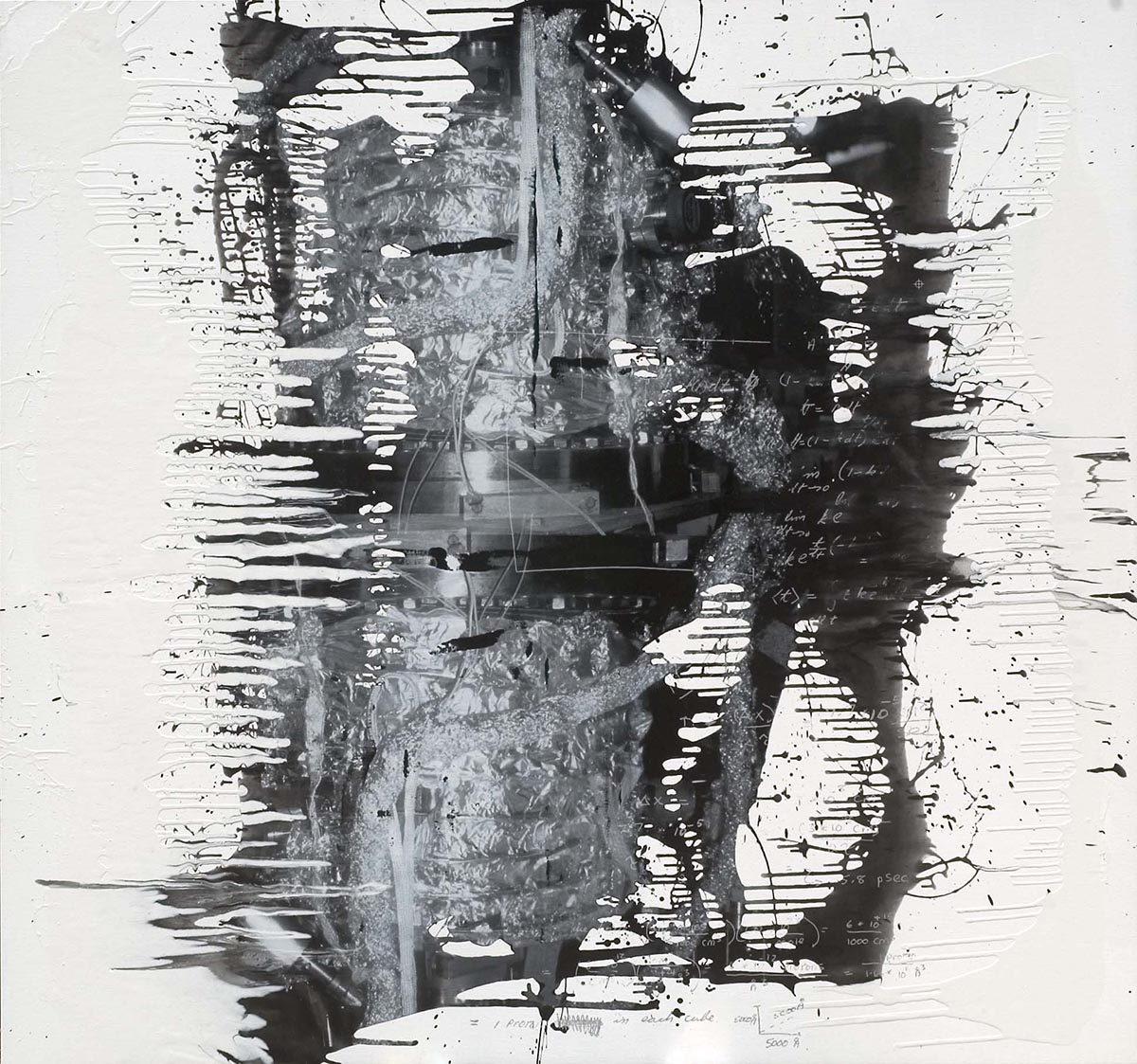
SM: All of my work is photo-based. That’s interesting to me because, while it’s photo-based, you look at images that are microscopic, technical, and graspable, and yet there are no references in them to what looks like the real world. If you’re sitting in front of the painting, in this exhibition, called Potassium Channel, it looks pretty abstract. People have commented that it looks like “a landscape,” an “aerial view,” or “a satellite view of the world.” In fact, the painting features a detail of the X-ray crystallography machines that Rod uses at Brookhaven National Laboratory to image his protein structure, so he can understand their function. The photograph, then, is both literal and abstract, and that’s the part of photography that I love. What I also like about photography is that it’s a quick way to get an image; one click and you’ve got it.

Potassium Channel, 2007, dispersion and silk screen on canvas, 80.5″ x 81″
MH: Yet, the work is far from what you’d characterize as photographic. You’re painting and drawing on top of and around images all the time.

SM: I would say that ninety percent of my practice is drawing, which I love because I can work through ideas quickly. Painting is different, slower and more process-oriented. And, then, there’s another visual language at work here—the texts and notations that come directly from Rod’s notebooks, which I’ve photographed, and that introduce a whole other kind of mark-making and meaning.

MH: Rod’s texts suggest graffiti, which, historically, has played an interesting and sometimes controversial role in painting.

SM: All that text is a record of touch; it’s about human presence, which I like in the midst of all this technical imagery and information. The human touch and presence is important in this body of work; it reflects part of the process of a scientific discovery that’s important because it helps explain how we function physiologically, biologically, and on a molecular level. The images and the text in this work are metaphors for the process of inquiry, of looking inside of the work we have to do.

MH: Meaning?

SM: Meaning, scientists are looking for something, looking for meaning, but so am I. So are you. So are most thinking people. We’re all asking questions, trying to understand what forces make or shape who we are. Lots of people talk about that as being the job and a goal of both art and science.

MH: One of the things I like to talk about with both scientists and artists is their appreciation of, and fascination with, the process of searching and dealing with their work when things do or do not fall into place. You’ve spent a lot of time with scientists. What’s similar about the ways artists and scientists work, about how they visualize and find their way through problems?

SM: For painters, for instance, part of the beauty of a painting is knowing when to stop. There’s a famous Monet quote: “The difference between me and any others is I know when to stop.” If you overwork a painting, you kill it. With science, you keep going, no matter what. You keep exploring. And scientists keep looking, too, but the process is different; they work with very specific tools. The freedom in art is that you can let anything happen. When I talk to scientists, they never feel like they have that freedom to play. When I work with scientists and we start using the equipment, they always want to get everything in focus, to make everything work, to get me a certain kind of image. And I tend to say, “No. I want just the opposite of that. Do something you’ve never done before. Make it out of focus.” They love to do that, but the equipment is so expensive and their tools are so rare, they feel they can’t waste time and have to be efficient. The freedom of art is something scientists appreciate and, even, envy. One of the reasons I’ve been successful in working with scientists is because I give them the opportunity to play on someone else’s dime.

MH: A quality of the work in this exhibition that interests me is how, in the process of exploring the way that science is presented in imagery, there’s a sense of spectacle and of the spectacular at work. The work is big. The images have an explosive quality about them. There’s a sense of special effects at work. There’s a sense of friction and excitement in the constant juxtaposition of language and image, the drawn versus the photographic. The work suggests that every body, every cell, literally and figuratively, is a spectacle, that something big is going on and needs to be looked at. And that something even bigger is yet to come.

If They Exist, 2007, dispersion and silk screen on canvas, 80″ x 81″
SM: I never thought about it that way until now, but the body is spectacular and the notion of spectacle is a big part of art and of culture. I’ve always been interested in work by artists like Jack Goldstein, who painted images of fireworks, volcanoes, and airplanes with contrails flying through the skies, dropping bombs. In work like that, there’s a sense of watching a spectacle from a distance. In my work, the spectacle is just as big, but it takes place close by and on a much smaller and more intimate scale. What Rod MacKinnon does in his work is astounding. He figured out how a positively charged ion moves across a cell membrane, from a protein to a cell, at a rate of a hundred thousand to a million ions per second. That’s a spectacle I never thought about as I was representing it, but when I step back and look at it, it is spectacular, on a macro-micro level. His work and the images it generates are cosmic in a sense; the ions he studies interconnect all of the electricity in the body so we can communicate with each other. Those are pretty incredible notions.

There’s another level of spectacle at work, too: the massive amounts of money being spent on this research. Drug companies stand to make huge profits when they find the specific protein that targets a specific cell that’s diseased. Which adds yet another level of complexity to the work: Science cures disease and makes money. The image of a virus or a protein that might kill or sidetrack disease looks beautiful in a painting. In that sense, the work mirrors the complexity of what’s going on in the world today.

MH: Since you’ve brought up macro-micro issues, let’s end by addressing the issue of scale in this work.

Liquid Wrap, 2006, spray enamel, dispersion, and silk screen on canvas, 57″ x 39.5″
SM: Conventionally, scientists see their images reproduced small scale, in the lab or when they’re published in journals. An image might get blown up in a PowerPoint presentation, but this kind of imagery is seldom seen on a large scale, or in a context removed from everyday work and the laboratory. When art and science intersect, it changes the context, beefs up the scale, and alters responses to imagery in unexpected ways. Images of the smallest of things become images you can get lost in. Scientists may not need or necessarily want that kind of scale or distraction. They’re making science; they’re looking for specific solutions. I’m making art and trying to communicate with a different audience, and scale is just one of the ways I try to do that.

What’s ultimately important about all of this is that things and events minute in scale are monumental in terms of meaning and impact. Images are central to that process. Rod’s work employs image-making for its function. Art is about function, too, but of a different kind. My job is to use specific kinds of images to grapple with the experiences of life and of culture, and to engage viewers in a dialogue about possibilities.

[1] Marshall McLuhan and Quentin Fiore, War and Peace in the Global Village (San Francisco: Hardwired, 1997), 12.


Curator and writer Marvin Heiferman organizes projects about photography and visual culture for institutions that include the Museum of Modern Art, Smithsonian Institution, International Center of Photography, Whitney Museum of American Art, and the New Museum.  A contributing editor to Art in America, Heiferman has also written for The New York Times, Artforum, Bookforum, Mousse, ArtNews, Aperture, and BOMB.  His most recent book is Photography Changes Everything(Aperture, 2012), and new entries to Heiferman’s Twitter-based project, WHY WE LOOK (@whywelook) are posted daily.

Contentations2013-09-12T00:19:59-04:00

New York Spy, August 2013

steve_miller

X-Ray of Brazil: The Art of Steve Miller

by  • Aug 5, 2013

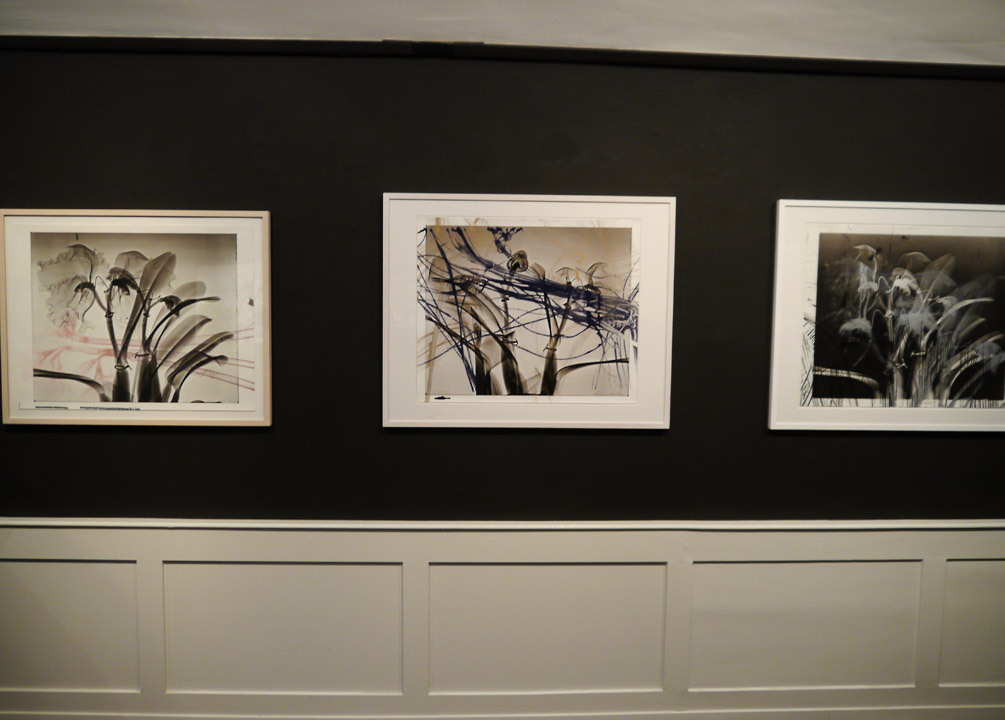
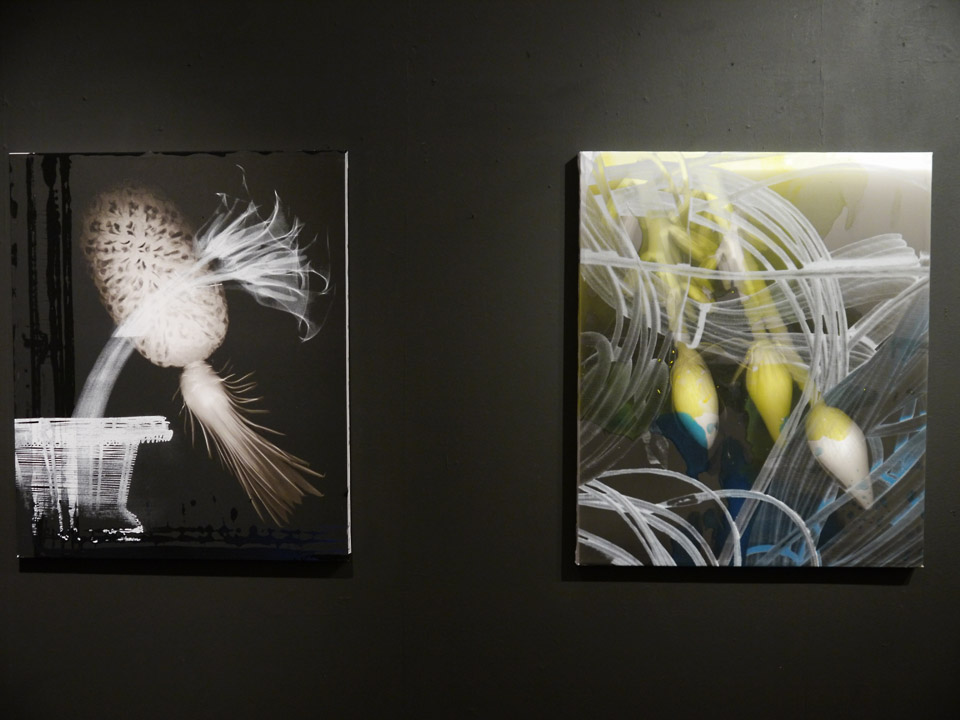
Renowned artist from New York, Steve Miller is a pioneer in using the computer in art. Curious to unravel the functioning of all, he adopted the X-ray machine as new artistic language: since 1993 photography and X-ray slides are seen in his work. Miller customizes images, creating an abstract result. His most recent work is called Health of the Planet and involves the Amazon Rainforest in creating prints that will be used by the Brazilian brand Osklen collection in 2013. In New York, Steve Miller spoke with Miriam Spritzer.
O artista norte-americano Steve Miller

Steve Miller

In a Portuguese almost as Brazilian as mine, Miller says he wanted to do a medical check up on the Amazon. The idea was to show to the world the different species of animals and plants of the region, in a more artistic and unusual way – hence the use of X-ray. The prints were so interesting and beautiful that it didn’t take long before Osklen wanted to incorporate it to it’s collection.

How did you end up in Brazil?

I first went to Brazil in 2005, along with other artists, we were invited by Nessia Leonzini (Pope), a Brazilian curator living in NY. She was putting together an affordable art fair – I contributed with a piece that was the X-ray of a foot kicking a soccer ball. During this trip I went to Rio, São Paulo and Salvador. I had the wish to spend more time in the country, but would have to have some idea to work in Brazil. Then at Ilha Grande I came across a jackfruit. I was so impressed! I have never seen anything like this before. So I started to wonder what would be inside of it and thought it would be cool to do an x-ray of this fruit. Then I decided that if the Amazon are the lungs of the world, as many say, I would make a medical check up in Brazil with an X-ray in his lung.
Tell us a little bit about the backstage of your work in Brasil.

The project had two phases. I started in São Paulo, making images of plants. Then moved to Pará, to do the work with the animals. I had lots of help from local artists and the people who worked in hospitals, producing the x-ray images. Generally we started at 6 pm and finished up the X-rays by dawn. We also did remote sensing image with a satellite of the Amazon Basin, for example.
Was there any cultural shock with the Brazilian culture?

For sure! We saw exactly what Brazil really is. In São Paulo things were fast, but it took three years for me to get the whole structure set in Belém do Pará, it was where I needed a larger structure – a zoo and a hospital. The radiologist Otávio Lobo was extremely important for the implementation of the project and was responsible for the best radiology center I have ever seen. Also I had the help of a student of mine, the Brazilian, Fabricio Branda. But it was very complicated to make it all happen, both by cultural differences and by language. Two examples: The first time I arranged with the zoo’s director, he did not show up at the appointed time (with time I learned that it is a little part of Brazilian culture). And, on the other hand, although Otávio only have an appointment at the hotel, he gave us a real tour of the city, took us to dinner, introduced us to people. Anyway, it was the definition of Brazilian hospitality.

Steve Miller for Osklen

How did you choose what you were going to X-ray?Besides the typical animals of the Amazon – Alligator, piranhas, sloths and anteaters – I chose everything I thought interesting or curious, or that could create a good image. The jackfruit ended up being very similar to the human lung, for example. On the public market of Belem, we bought all kinds of fish. And the zoo we had the help of a veterinarian to select the animals and also plan how to get them.
What did you find most impressive during this work in Brasil?

The size of the flower market in São Paulo. It is gigantic! Furthermore, the amount of different species that could be found there or at the Belém Zoo. We did a boat trip on the Amazon River, and that feeling of being inside the forest is inexplicable. I admit too that really wanted to take an anteater home, they are cutest things, but of course it is not possible. On the negative side, I was very surprised at the lack of structure in some places: the zoo of Belém did not have any kind of documentation about the animals, much less X-ray machines for their health.
How did the partnership with Osklen begin?

I already knew Osklen for a while, used to always buy something there when I went to Brazil. When I had the idea for the project I thought it would be interesting to have these images in shirts and shorts, and even more because the company has the approach to be socially responsible. By chance I met Oskar Metsavaht at Brazil Foundation gala we were introduced and I did not know that he was the designer brand. We talked and he told me he had recently gone to Belém in search of fabrics for clothing. It was then that I discovered that he was the Osklen’s Oskar! So I said: “I have a great idea for you”. And so the partnership happened.
* This article was originally published on RMmag.

New York Spy, August 20132013-09-22T21:17:59-04:00
Go to Top