

Publication of Day Dreams at Long House

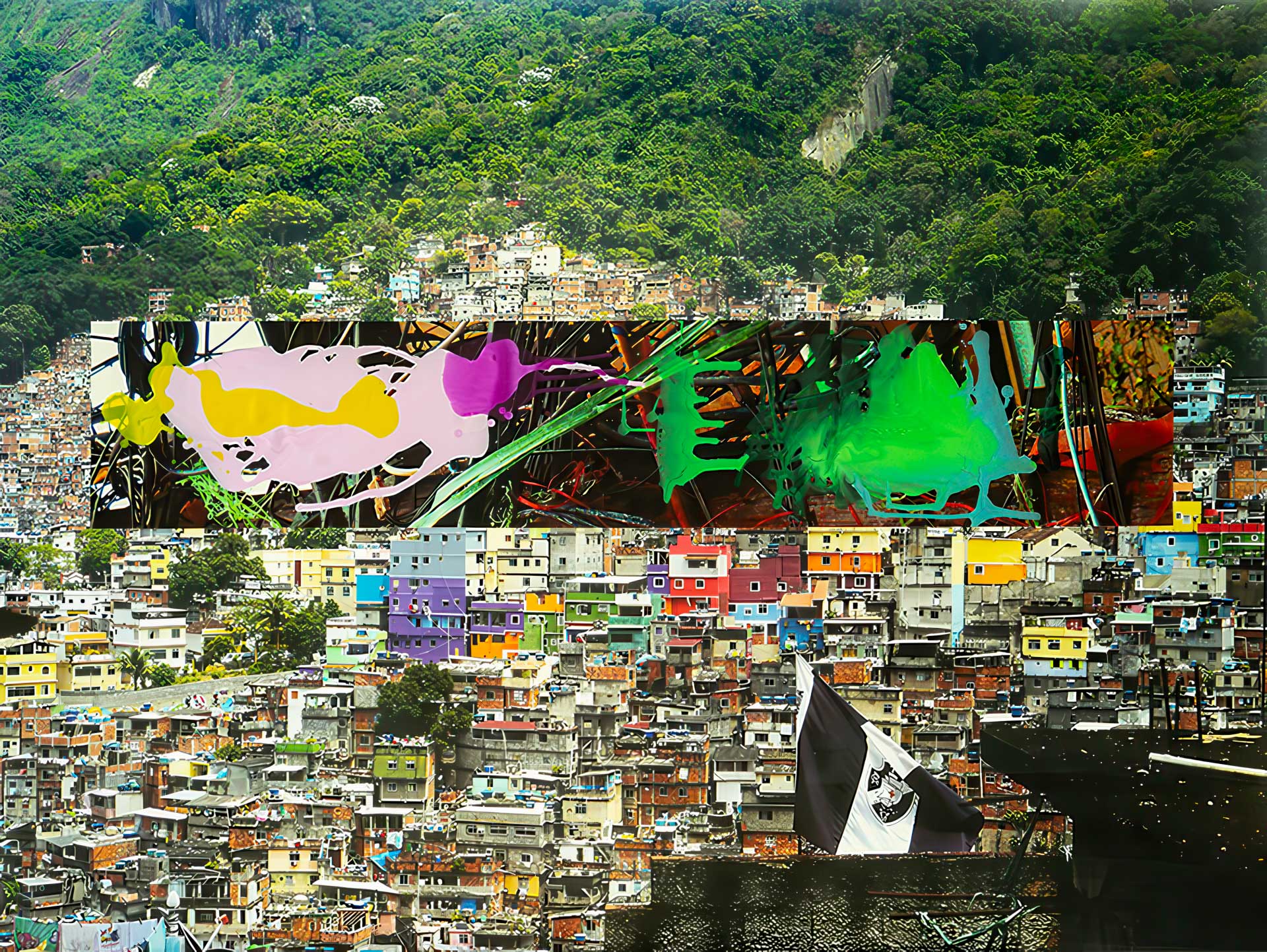
Inkjet, pigment dispersion on canvas
43 x 57 inches
DAY DREAM by Steve Miller
I would sit on the rooftop of my friend Simon Lane’s apartment in Rio de Janeiro and look across from his beachside building to the vast favela spilling down the mountainside. I wondered what the world was like inside. The view was a living wall of humanity — boxes stacked upon boxes — nestled into the coliseum-shaped bowl of the mountain.
The film City of God had already sparked my imagination. Simon regaled me with stories of venturing into the favela one night with the Brazilian artist Tunga, allegedly in search of danger and drugs. I listened with envy, safe on the roof while my mind followed them into the dark.
At night, Rocinha, the favela under discussion, glowed with lights like a constellation on the mountainside that offered no answers to my questions about daily life in one of the most densely populated neighborhoods in Rio. Employees from Simon’s building lived there, as did many workers from São Conrado, which flowed from the beach up the mountain to where Rocinha met the Gávea neighborhood on the other side. Power belonged to the drug lords, and the casual wanderings of a suburban boy from Buffalo was inconceivable.
With each visit to Simon’s apartment, I daydreamed about life in Rocinha. My imagination conjured images of territorial turf wars I saw on the news, occasional military invasions, unrelenting poverty, and a vibrant city existing apart from the universe I knew. I felt compelled to go inside and document what had lived only in my imagination. I felt a pull toward danger, but also understanding. I wanted to step inside what I had only imagined.
Through Rocinha grammar school students who attended classes at the Gávea art school, Parque Lage, I found an entry point. I gave the children cameras and asked them to document the chaotic development and infrastructure related to my Brazilian project, Saúde do Planeta (Health of the Planet). Instead, they returned with photographs of their friends and families — not the assignment I had given them, but something far more revealing. These images satisfied my curiosity about family life in the favela and they introduced me to a paid bodyguard to guide me through Rocinha.
Over the years, I made several visits and took more than a thousand photographs. Some of my guides welcomed me into their modest homes and instructed me when and where photography was forbidden. On more than one occasion, we had to duck into a bar to avoid being seen during a drug transaction taking place in the middle of the road. Bare-chested, skinny preteens carried automatic weapons, overseeing commerce with their youth shielding them from prison.
Remarkably, it was the tangled web of electrical wires that most captured my attention, that was the original focus of the student assignment. The wires — chaotic, knotted, brilliant — carried the same urgency as the lives below them, Those streaming electrons carried the pulse of an improvised city. To this day, this archive of risk, resilience, and radiant disorder continues to guide my work.
